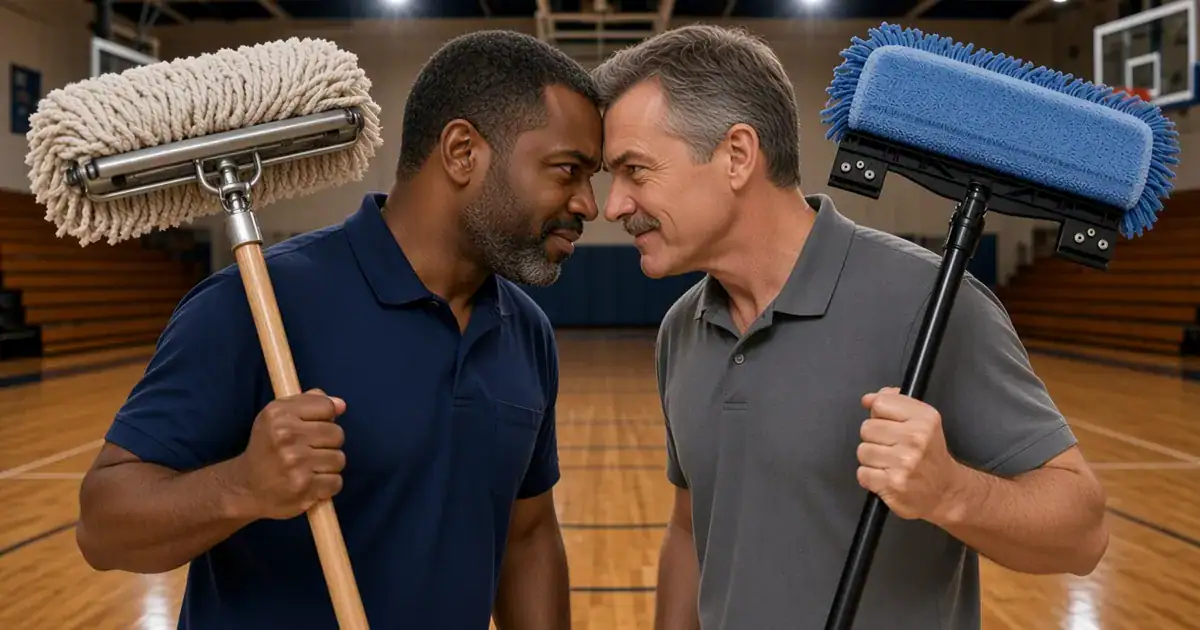
Ask five custodians whether you should treat a gym floor dust mop and you’ll probably get six answers. Some swear a treated mop is the only way to really pick up dust. Others say nothing should ever go on a mop that touches the court.
The disagreement makes sense once you see who’s giving the advice. Floor makers, finish makers, contractors, and the people who push the mop every morning are each looking at a different part of the same problem. So we’re giving both sides a fair hearing over four rounds, then telling you what we’d do.
The short version: There isn’t one right answer for every gym. The deciding factor is your floor finish and what its manufacturer recommends. When both methods are approved, personal preference and the type of dust mop you use can help determine which approach works best.
Meet the Two Sides
In The Red Corner: “Treat the Mop”
Some floor makers, treatment makers, and plenty of veteran custodians are in this corner. Robbins Sports Surfaces, for example, calls for daily sweeping “with a properly treated dust mop” to keep the floor free of dust, grit, and abrasive particles, and it points owners to their finish manufacturer for approved maintenance products. The idea in this camp is that a treated mop holds onto dust instead of pushing it around or sending it back into the air. Many longtime custodians also say they simply prefer the pickup they get from a treated cotton mop.
In the Blue Corner: “Never Treat It”
Some finish makers, GameTime (for its vinyl court graphics system), and many sports floor contractors are in this corner. The concern in this camp is that treatment residue can affect traction and cause problems when it’s time to recoat. Most in this camp use a clean, untreated microfiber dust mop.
The Referee: MFMA
The Maple Flooring Manufacturers Association (MFMA) sits in the middle. Its daily floor care guidance says to sweep daily “with a properly treated dust mop,” and up to three times a day on heavily used floors. Its new maple floor guidance adds that you should never use dust mops treated with silicone, wax, or acrylic-based products, and that your floor finish manufacturer has treatments designed to be compatible with its finish. In other words, MFMA hands the final decision to your finish maker.
Round 1: Dust Pickup
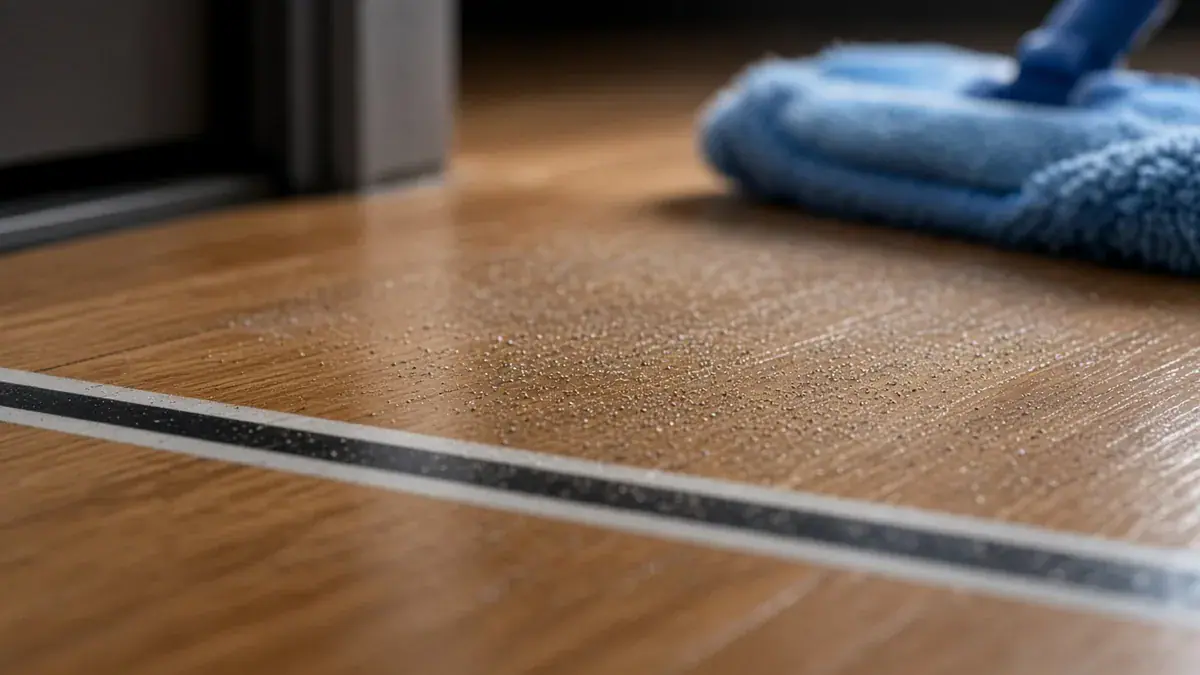
The treat corner: A treatment is meant to make the mop grab dust and hold it. The manufacturer of the water-based treatment we carry describes the goal as turning dust mops into “dust magnets,” and MFMA’s daily guidance is written around a properly treated mop.
The never corner: One finish maker’s floor care system instructions say to dry dust daily with a microfiber dusting pad and state, “DO NOT USE ANY DUST MOP TREATMENTS.” Microfiber is designed to attract and hold fine dust on its own. The product pages for the microfiber dust mop systems we carry say they need no treatment, and you’ll find replacement microfiber dust mop heads in our Mop Heads category.
The call: a draw. Both approaches pick up dust when the mop matches the finish system. Both corners also agree on the bigger point: dust the floor every day, and more often when it’s busy.
Round 2: Cotton vs. Microfiber
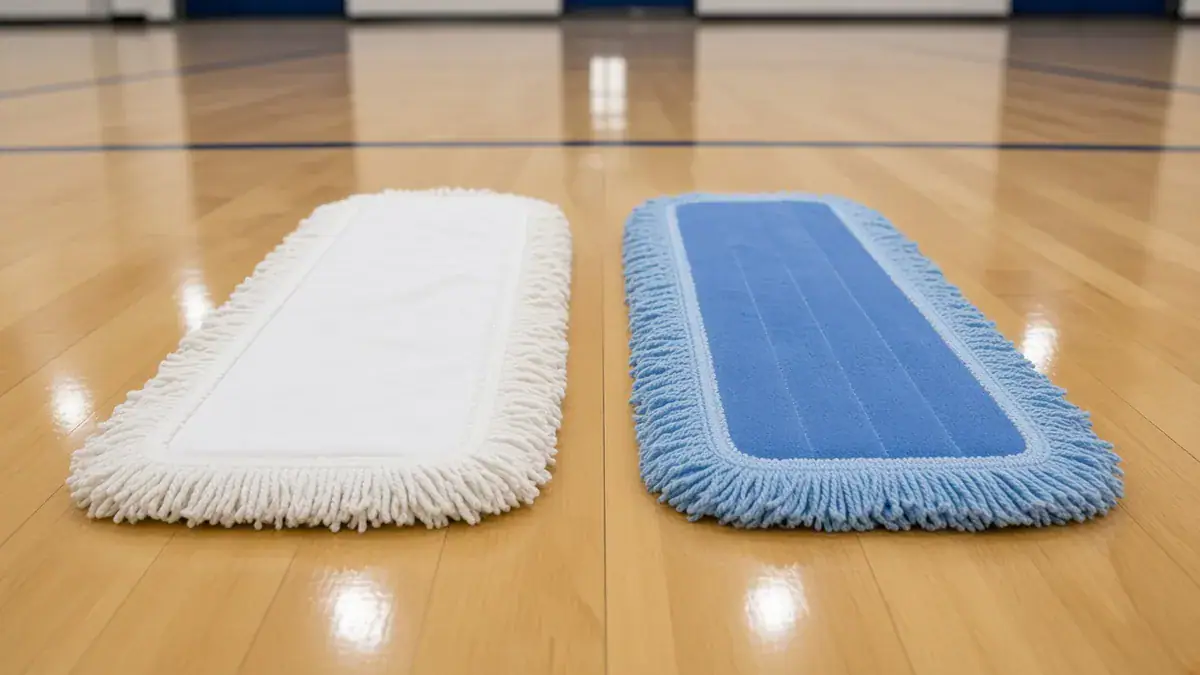
The treat corner: Treated programs traditionally use a cotton dust mop, and many veteran custodians still prefer one. If your finish maker calls for a treated mop, a standard wire frame like our Quick-Change Wire Dust Mop Frame works with cotton or microfiber heads, according to its product page.
The never corner: Rob Zehnder of Lord of Wood, a sports floor contractor quoted in Coach & AD, puts it bluntly: “Use a microfiber mop and never treat it with anything.”
The call: a split decision. The right mop type follows your finish system. When your finish maker allows either one, we lean microfiber, because it needs no treatment and the heads can be laundered and reused. Just keep the heads clean so they don’t drag grit across the floor.
Round 3: Traction and Slippery Floors
The treat corner: Treat lightly and treat ahead of time. The manufacturer of the water-based treatment we carry says to lightly mist the mop without oversaturating it, and that best results come when mops are treated and stored in plastic bags overnight. That means no treating right before practice or a game.
The never corner: GameTime’s Full Court Prep page says not to use pre-treated dust mop treatments or floor cleaners that contain wax, paraffin, silicone, or mineral oil with its vinyl court graphics system. A Coach & AD article warns that furniture cleaning and shining products can make gym floors “as slippery as ice rinks,” and that oil soaps can affect the ability to recoat later.
The call: the never corner wins on oil-based and household products. Both corners share the same risk: applying a treatment too heavily or too close to game time.
Round 4: Recoat Day
This is the round where guessing can cost you.
The never corner: Some finish data sheets rule out treatments in their curing instructions. One sports floor finish data sheet, for example, says, “Do not use dry dust mop treatment chemicals on wooden floors.” Recoat prep is strict too. The technical data sheet for the Excelsior OMU Finish 350 we carry says all surfaces to be coated must be “clean, dry and free from dirt, oil, wax, soap residue” and other foreign matter. MFMA also rules out silicone-, wax-, and acrylic-based treatments.
The treat corner: MFMA notes that finish manufacturers offer dust mop treatments designed to be compatible with their own finishes. If your finish maker supplies or approves one, you’re working inside its system.
The call: a clear win for the never corner on any treatment your finish manufacturer hasn’t approved. Residue left on the floor can get in the way of a good recoat, and that’s an expensive surprise in the middle of summer.
Oil-Based vs. Water-Based: What Actually Matters
It’s tempting to assume a water-based treatment is automatically safe for a polyurethane sports floor. It isn’t that simple. Water-based doesn’t automatically mean approved for your finish, and oil-free doesn’t guarantee recoat compatibility. What matters is what’s in the treatment, what it leaves behind on the floor, and whether your specific finish manufacturer accepts it.
For example, we sell Dust Trax Water Based Dust Mop Treatment. According to the manufacturer, it’s a ready-to-use, water-based treatment that’s safe to use on finished floors and leaves no oily residue to attract dirt and grime. That’s a good starting point, but your finish manufacturer still gets the final word.
The Scorecard and Our Verdict
| Round | Treat corner | Never corner | The call |
|---|---|---|---|
| 1. Dust pickup | Treated mop holds dust | Clean microfiber holds dust | Draw |
| 2. Cotton vs. microfiber | Treated cotton | Untreated microfiber | Split decision: follow your finish system |
| 3. Traction | Treat lightly, the night before | No oil, wax, silicone, or household sprays | Never corner, for oil and household products |
| 4. Recoat day | Use the finish maker’s approved treatment | No residue on the floor | Never corner, for any treatment your finish maker hasn’t approved |
Final result: a split decision, and your finish manufacturer is the judge.
Our recommendation: For most facilities, we prefer a clean, untreated microfiber dust mop when your floor finish manufacturer permits it. It requires no treatment, and it reduces the risk of putting an incompatible chemical on your finish. If your finish manufacturer specifically recommends a treated cotton mop, follow that system instead.
Treated Cotton vs. Untreated Microfiber at a Glance
| Treated cotton dust mop | Untreated microfiber dust mop | |
|---|---|---|
| Requires chemical treatment | Yes. The head is treated before use and re-treated on a schedule. | No. The microfiber systems we carry are sold as needing no treatment. |
| Dust collection | The treatment helps the mop attract and hold dust instead of pushing it. | Microfiber is designed to attract and hold fine dust without treatment. |
| Finish compatibility | Only with a treatment your finish maker approves. MFMA rules out silicone, wax, and acrylic-based treatments. | Matches finish systems whose makers prohibit treatments. Still confirm with your finish maker. |
| Recoat concerns | Treatment residue can build up. Stop treating before a recoat as your contractor or finish maker directs. | No treatment residue, but a dirty head can still spread grit. |
| Maintenance | Shake out or vacuum after use, re-treat, and launder per the mop and treatment makers’ directions. | Shake out after use and launder regularly without fabric softener. Replace worn heads. |
| Our preference | Use it when your finish manufacturer specifically recommends it. | Our first choice for most gyms when the finish maker permits it. |
What Experienced Custodians Do Differently
These tips come from working custodians and floor contractors. They’re practical habits, not rules, and they never override your finish manufacturer’s instructions.
- Keep a gym-only dust mop. Store it separately so it doesn’t pick up grit from hallways and cafeterias.
- Dust before the floor gets busy. Many facilities dust before practices and games, and MFMA suggests up to three times a day on heavily used floors.
- Shake out or vacuum the head after every use. A loaded head just moves grit around.
- If you treat, treat the night before. Mist lightly, follow the treatment maker’s directions, and never treat right before a game.
- Launder on a schedule. John Praters of Praters Flooring, quoted in Coach & AD, says to launder or replace the mop when soil and residue build up. The makers of the microfiber heads we carry say to avoid fabric softeners.
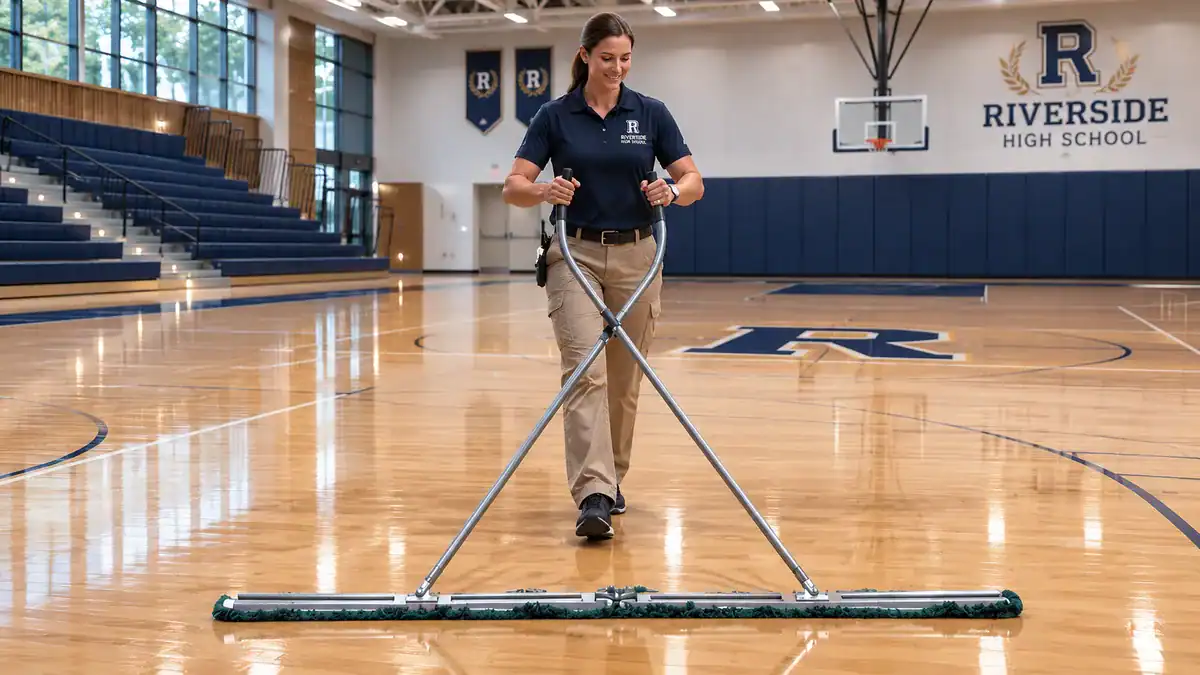
- Use a wider mop for big floors. A wide or scissor-style duster makes frequent dusting realistic in a large gym or field house.
Even the pros don’t fully agree. A single Coach & AD article says the gym dust mop “should not be treated with any cleaning substance,” then quotes a contractor who says to “treat the dust mop once per week.” That’s exactly why your finish manufacturer’s guidance comes first.
How to Choose the Right Approach for Your Gym
- Find out what finish is on your floor. Ask your floor contractor, or check your last recoat records.
- Follow that finish manufacturer’s dust mop instructions. If they say no treatment, that settles it.
- If both methods are approved, pick based on preference and your mop. We lean toward clean, untreated microfiber. If you prefer a treated cotton mop, use only a treatment your finish maker approves.
- If you treat, keep it light. Apply it the night before and never use silicone, wax, acrylic, or household sprays.
- Protect recoat day. Keep the mop gym-only and clean, and stop all treatment before a recoat as your contractor or finish manufacturer directs.
After dusting, a damp clean removes what the dust mop leaves behind. A pH-neutral cleaner like Tac-Tite, used with the CourtClean 6 ft Damp Mop System, is an option for routine cleaning when properly diluted and used as directed.
Recommended Products
For untreated microfiber (our preference):
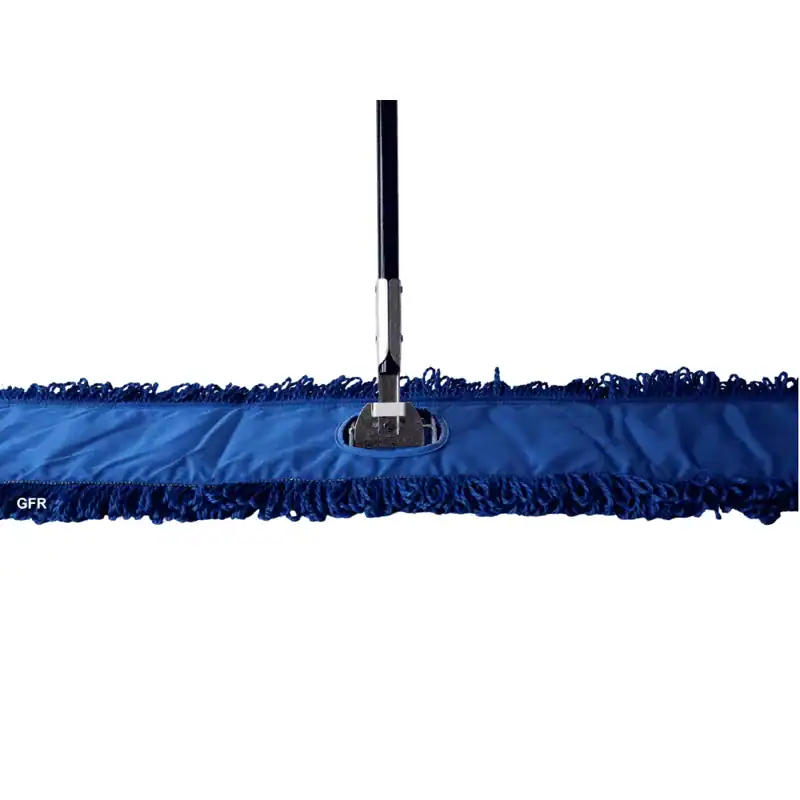
- Wire Frame Microfiber Dust Mop System: a handle, 5-inch wire frame, and statically charged microfiber head. The product page says the head requires no additional treatment and can be laundered hundreds of times. Sizes run from 18 to 72 inches.
- Dust Defender Microfiber Gym Mop System Combo: a dust and damp mopping system with launderable microfiber heads and a free laundry bag. The product page says the heads attract 7x more dust than traditional cotton mops and need no chemical treatments.
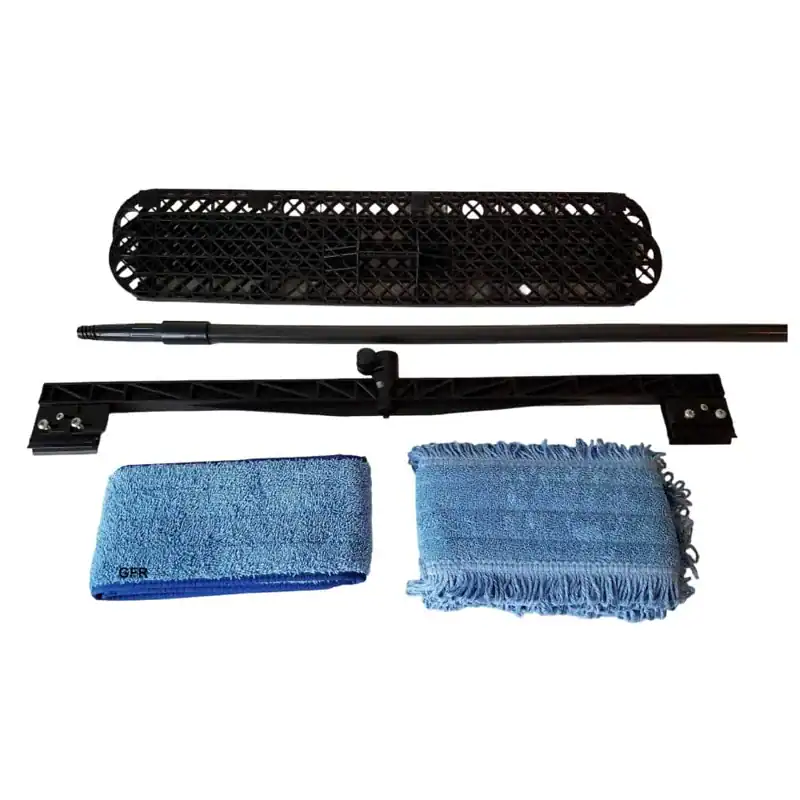
- Tac-Tite Microfiber Dust Mop Heads: looped-end, launderable microfiber heads with a Velcro backing for Tac-Tite Mop Frames.
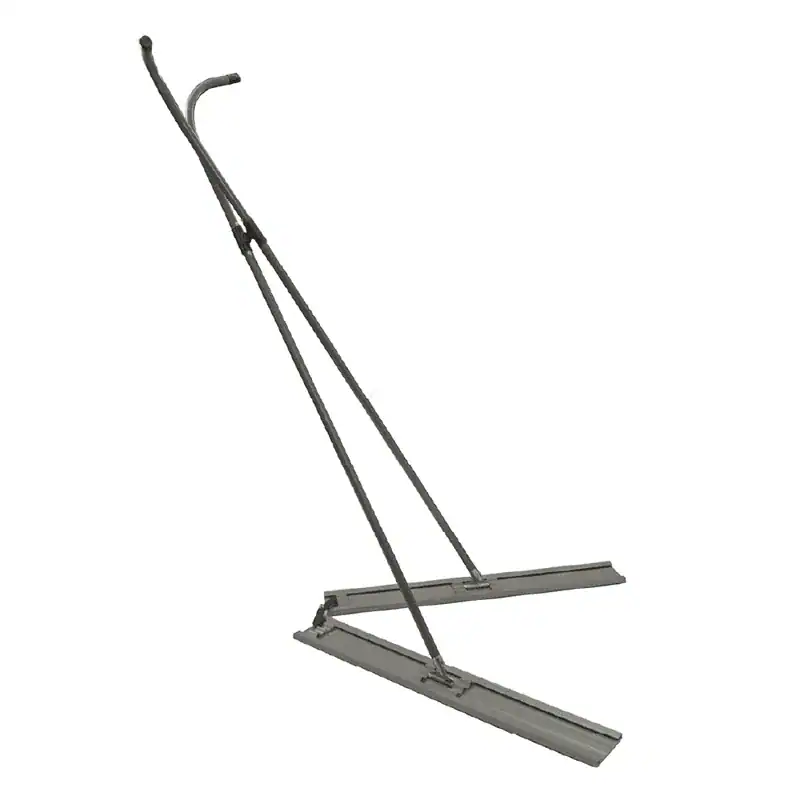
- Big Job Duster Mop System: a scissor-action duster that covers up to 6 to 8 feet per pass and funnels debris to the center. Frames come with Velcro backing for microfiber heads or open-back.
If your finish manufacturer approves a treated mop:
- Dust Trax Water Based Dust Mop Treatment: a ready-to-use, water-based treatment. Use it only when your finish manufacturer approves it, and follow the manufacturer’s directions.
- Quick-Change Wire Dust Mop Frame: a wire frame in 18- to 72-inch sizes that works with cotton or microfiber heads, according to its product page.
Shop all Dust Mops, Mop Heads, and Mop Frames.
Frequently Asked Questions
Do I need to treat my dust mop for a hardwood gym floor?
Not necessarily. MFMA’s daily care guidance calls for a properly treated dust mop, while some finish makers say to use no treatment at all with their finish systems. Your floor’s finish manufacturer decides. If it allows either approach, a clean, untreated microfiber mop is the simpler choice.
Can dust mop treatment make a gym floor slippery?
It can. Heavy or oily treatments can leave residue on the court, especially when a mop is used right after treating. For its vinyl court graphics system, GameTime warns against treatments and cleaners with wax, paraffin, silicone, or mineral oil. If your finish maker approves a treatment, mist it on lightly and let the mop sit overnight.
Is microfiber or cotton better for a wood gym floor?
Microfiber is designed to grab and hold dust without treatment, and the heads can be laundered and reused. That’s why we prefer it when the finish maker allows it. Cotton is the traditional choice for treated programs. If your finish manufacturer specifically calls for treated cotton, follow that system.
Will dust mop treatment cause problems when we recoat the floor?
It can if residue builds up. Finish data sheets we’ve reviewed, including one for a finish we carry, call for a floor that’s clean and free from wax, oil, and other residues before a new coat goes on. Before recoat season, ask your contractor when to stop treating, and follow the finish manufacturer’s prep steps.
Is a water-based dust mop treatment safe for every gym floor?
Not automatically. Water-based doesn’t mean approved for your polyurethane sports finish, and oil-free doesn’t guarantee recoat compatibility. What matters is the ingredients, any residue left behind, and whether your specific finish manufacturer accepts the product. Check with them before switching treatments.
How often should we dust mop the gym floor?
MFMA says to sweep daily and up to three times a day on heavily used floors. Many facilities also dust right before practices and games so grit doesn’t get ground into the finish. Clean or change the mop head as soon as it starts to look loaded.
How do I clean a dust mop head?
Shake it out or vacuum it after each use. Launder microfiber heads regularly without fabric softener, which the makers of the heads we carry say to avoid. Launder or replace any head that stays loaded with soil or residue, and follow the mop maker’s care instructions.