A gym floor inspection helps identify potential safety hazards, moisture problems, finish wear, and structural concerns before they lead to more costly repairs. Regular inspections should include checking for spills, gaps between boards, cupping, buckling, dead spots, slippery areas, and changes in temperature and relative humidity.
Gym Floor Resource developed this gym floor inspection checklist for athletic directors, facility managers, custodians, and contractors responsible for maintaining hardwood gym floors. Based on guidance from the Maple Flooring Manufacturers Association (MFMA) and leading sports flooring manufacturers, it organizes inspections into daily, monthly, seasonal, and annual tasks.
Download the free printable gym floor inspection checklist (PDF) and keep a copy with your facility’s maintenance records.
What Is a Gym Floor Inspection?
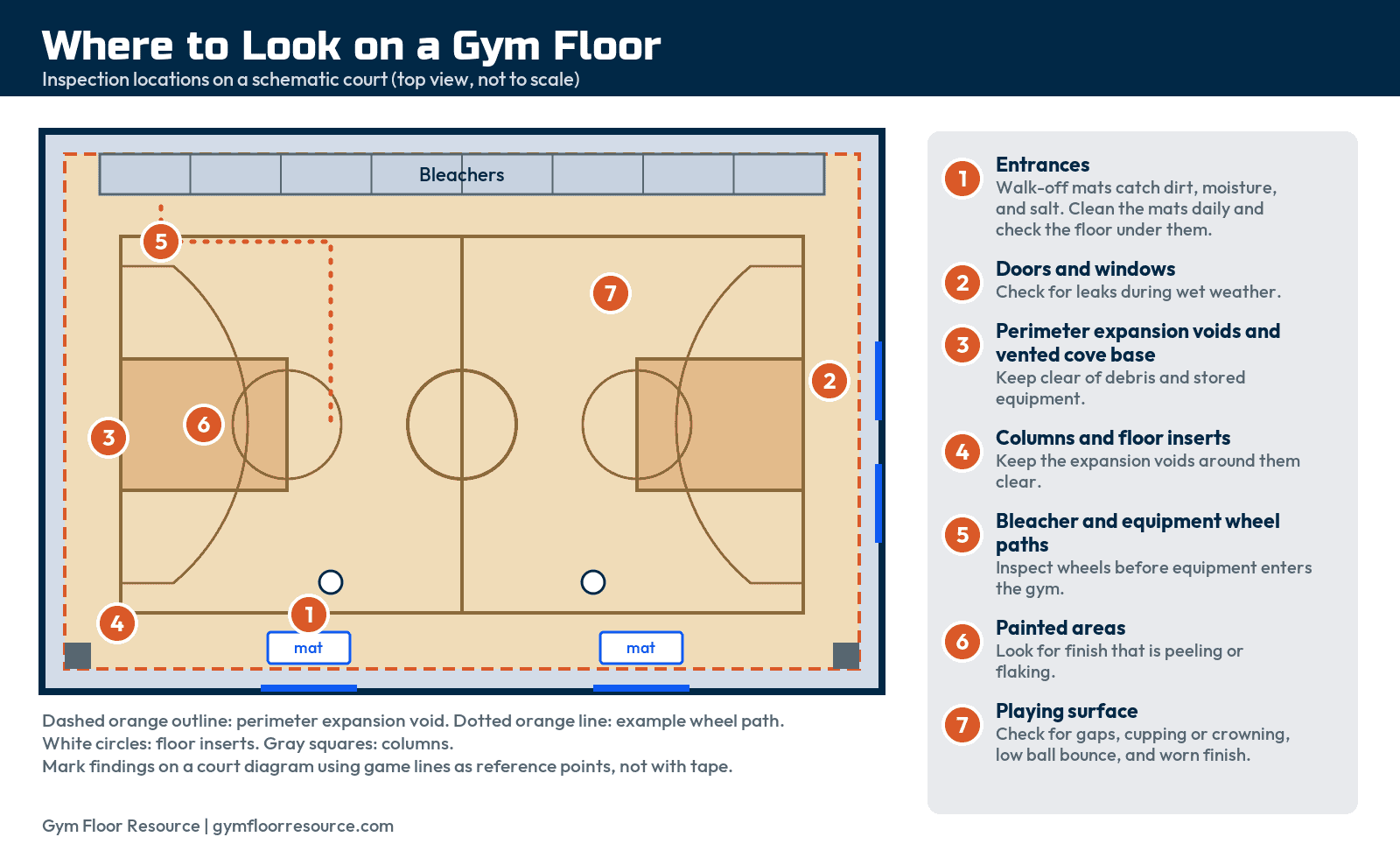
A gym floor inspection is a visual and hands-on check of the playing surface, the finish, the edges of the floor, and the room conditions around it. MFMA’s daily care steps for maple sports floors include inspecting the floor for tightening or shrinkage, checking for water leaks around doors and windows during wet weather, and removing debris from expansion voids.
An inspection is not a repair. When you find damage, MFMA advises consulting your MFMA sports floor contractor before you modify or repair the floor.
How Often Should You Inspect a Gym Floor?
Gym Floor Resource recommends inspecting wood gym floors daily, monthly, seasonally, and annually, with additional inspections following water leaks, major events, or significant changes in indoor humidity. This suggested inspection schedule is based on MFMA and sports flooring manufacturer maintenance guidance and should be adjusted according to facility use, floor condition, and manufacturer requirements.
Daily Checks
Perform a quick visual inspection before the gym opens for activities and during routine dust mopping. Look for spills, grit, scuffs, slippery areas, loose or raised boards, and moisture near entrances. Record the room temperature and relative humidity.
MFMA recommends daily dust mopping with a properly treated dust mop, increasing to as often as three times per day on heavily used floors. Always use dust mop treatments compatible with your gym floor finish.
Monthly Checks
Once a month, walk the whole floor, the edges, and every entrance. Robbins Sports Surfaces lists a monthly full-floor cleaning with an approved cleaner, so it is a good time to pair the two. Also walk the floor after heavy rain or a big event.
Seasonal and Before Breaks
Humidity changes with the seasons, and closed buildings can drift out of range. MFMA’s closure guidance says to confirm that holiday or unoccupied settings maintain the required temperature, humidity, and ventilation, and to check readings during the closure.
Annual Inspection Before Screen and Recoat
MFMA recommends an annual screen and recoat for most maple gym floors. Its screen and recoat guide starts with an inspection: note and report any damage or condition that may lead to injury, then measure and record temperature and relative humidity before work begins.
Printable Gym Floor Inspection Checklist
Use this table as your walk-through. The printable PDF version adds sign-off lines, a reading log, and a court diagram for marking problem spots.
| When | What to Look For | Why It Matters | What to Do |
|---|---|---|---|
| Daily | Dust, grit, and debris on the playing surface | Dirt and grit act like abrasives and can scratch and dull the finish. | Dust mop with a properly treated dust mop. Heavily used floors may need it up to three times a day. |
| Daily | Spills, standing water, and wet footprints | MFMA calls water a wood floor’s worst enemy. | Wipe up right away with a thoroughly wrung soft cloth. Avoid wet mopping. |
| Daily | Walk-off mats at every entrance | Mats catch dirt, moisture, and salt. Mats left down too long can trap moisture or discolor the floor. | Remove and clean the mats daily, and check the floor underneath. |
| Daily | Heel marks and scuffs | Marks build up and make the floor look worn. | Remove with an approved floor cleaner on a soft cloth or dust mop. |
| Daily | Slippery areas and loose or raised boards | These can be safety hazards. Household cleaning products can leave a floor sticky or slippery. | Use only cleaners approved for your finish. Restrict access to loose or raised boards and contact a qualified sports flooring contractor. |
| Daily | Room temperature and relative humidity | Maple expands in humid air and shrinks in dry air. | Record the reading. MFMA recommends 55°F to 75°F and RH held within a 15% range, such as 35% to 50%. |
| Monthly | Gaps between boards | Some gaps are normal in dry months. MFMA considers a gap that fits a quarter excessive. | Note the location and RH. If wide gaps persist while the room stays in range, contact your flooring installer. |
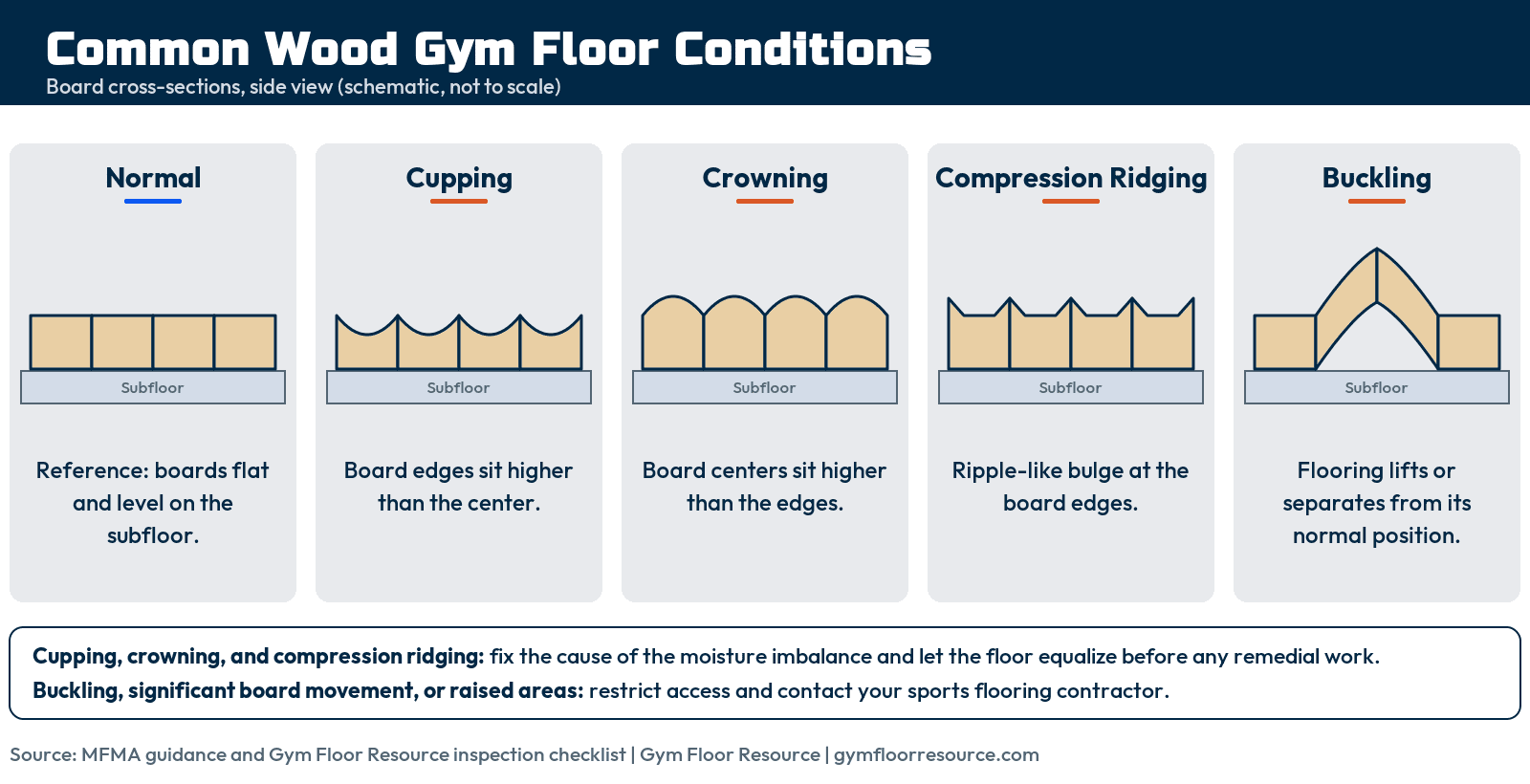
| Monthly | Tightening, raised board edges (cupping), raised centers (crowning), or ridges | These come from a moisture imbalance in the boards. | Fix the cause of the moisture imbalance (water below the floor or overly dry air above) and let the floor equalize. Call your contractor before any sanding or repair. |
| Monthly | Buckled or separating flooring, significant board movement, or raised areas | Buckling occurs when flooring lifts or separates from its normal position, often as a result of excessive moisture or expansion. | Restrict access and contact your sports flooring contractor. Do not sand until the moisture source has been addressed, the floor has stabilized, and a qualified contractor has evaluated it. |
| Monthly | Leaks at doors, windows, roof, drains, and downspouts | Leaks put water on or under the floor. | Check after wet weather and have leaks corrected right away. |
| Monthly | Expansion voids, wall base, columns, and floor inserts | These spaces let the floor expand and contract. MFMA notes perimeter voids also ventilate the floor system. | Remove debris and keep the spaces clear. Do not block them with stored equipment. |
| Monthly | Areas where the ball bounces low | MFMA defines a dead spot by low ball rebound, not by sound. | Mark the spot on a court diagram (not with tape) and report it to your sports floor contractor. |
| Monthly | Squeaks | Some squeaks are normal while a new floor acclimates, but some can point to a subfloor problem. | Log the location. Contact your sports flooring contractor if squeaking is persistent or unusual. |
| Monthly | Finish that is worn through, peeling, flaking, or slippery | Finish protects the wood and affects traction. MFMA notes peeling over painted areas is often tied to big humidity swings. | Report it and confirm the right cleaner and finish with your finish manufacturer or contractor. |
| Monthly | Wheels on bleachers, carts, lifts, and portable goals | Crowned or center-ridged wheels create point loads that can seriously damage the floor. | Inspect wheels before equipment enters the gym and protect the floor when moving heavy loads. |
| Seasonal and Breaks | HVAC settings for weekends, holidays, and summer | MFMA advises against shutting down ventilation for long periods. | Confirm unoccupied settings, check readings during the closure, and name who to call if readings drift. |
| Seasonal and Breaks | Floor covers used for events | Covers left in place too long can keep the maple from adjusting to the room. | Use covers only after the finish has fully cured, and limit how long the floor stays covered. |
| Annual | Overall condition before the screen and recoat | MFMA recommends an annual screen and recoat for most gym floors. | Note and report any damage that could cause injury. Measure and record temperature and RH before work starts. |
| As Needed | Whole floor, edges, and entrances after water leaks, major events, or significant changes in indoor humidity | Gym Floor Resource recommends additional inspections after water leaks, major events, or significant changes in indoor humidity. | Repeat the monthly checks and record the room temperature and relative humidity. |
What to Look For on a Wood Gym Floor
Gaps Between Boards
Maple absorbs and releases moisture as the air changes. In dry months the boards shrink and small gaps open up. MFMA says shrinkage cracks during drier months are not unusual and normally close as humidity rises. Its rule of thumb is that a crack wide enough to fit a quarter is considered excessive. If cracks persist while the room has stayed within the recommended conditions, contact your flooring installer or MFMA.
Cupping, Crowning, Buckling, and Compression Ridging
Cupping is when the edges of a board sit higher than its center. MFMA explains that it comes from more moisture in the bottom of the board than the top, for example from moisture under the floor, water from wet mopping getting between the boards, or overly dry air above the floor. Crowning is the opposite shape, with the center higher than the edges. Compression ridging is a ripple-like bulge at board edges from over-expansion. MFMA’s advice is the same for all three: fix the cause of the moisture imbalance and let the floor equalize before any remedial work. Equalization often clears cupping without further action. Buckling occurs when flooring lifts or separates from its normal position, often as a result of excessive moisture or expansion. If you notice buckling, significant board movement, or raised areas that could create a tripping hazard, restrict access and contact your sports flooring contractor promptly.
Do not sand a cupped or otherwise moisture-damaged floor until the moisture source has been addressed, the floor has stabilized, and a qualified contractor has evaluated its condition.
Dead Spots and Squeaks
MFMA defines a dead spot as a location where ball rebound is markedly less than on most of the floor. A difference in sound alone does not indicate a dead spot. A dead spot is an area where ball rebound is noticeably reduced compared with the surrounding playing surface.
As a simple screening step (not an MFMA test), bounce the same basketball from about the same drop height in the suspect spot and on the floor a few feet away. Then mark the spot on a court diagram and tell your contractor whether the ball bounced low or just sounded different. Formal ball rebound testing uses test equipment, so ask your sports floor contractor to evaluate any area you flag. MFMA also notes that some squeaks are normal while a new floor acclimates, but some can point to a subfloor problem, so log them too.
Finish Wear, Peeling, and Slippery Areas
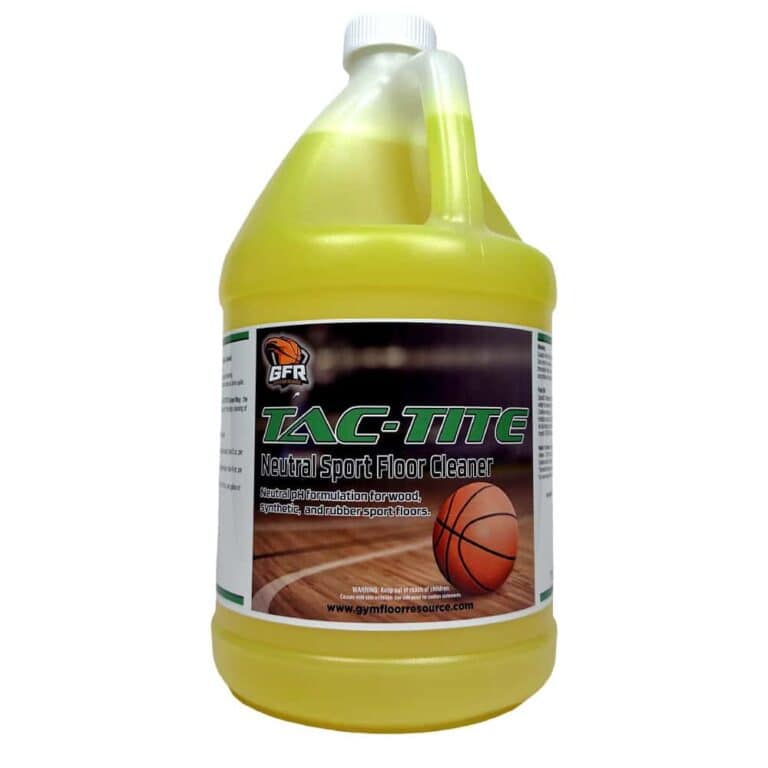
Look for areas where the finish is worn thin, flaking, or peeling. MFMA notes that finish peeling over painted areas, such as solid painted basketball keys, often shows up when the floor goes through large swings in humidity. Household cleaning products can leave a floor sticky or slippery, so use only cleaners approved for your finish. Explore our gym floor cleaners, such as Tac-Tite pH Neutral Gym Floor Cleaner, and confirm compatibility with your finish manufacturer. For black heel marks on daily rounds, the Scuff Ace scuff mark remover lets staff work standing up.
Water, Leaks, and Entrances
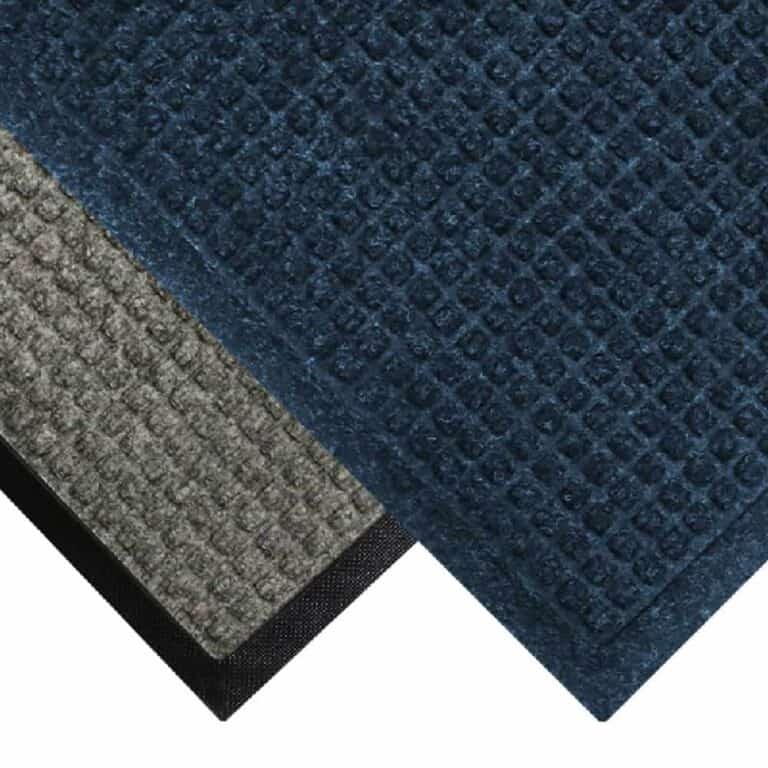
MFMA recommends walk-off mats at gym entrances to capture dirt, moisture, and salt before they reach the maple. Remove and clean the mats daily and inspect the floor under them. Connor Sports also recommends routinely inspecting ductwork insulation, interior drains, and downspouts, and Robbins says all leaks must be corrected immediately. Shop our entrance mats, and in winter see our guide to protecting a gym floor from salt and ice melt.
Expansion Voids and Wall Base
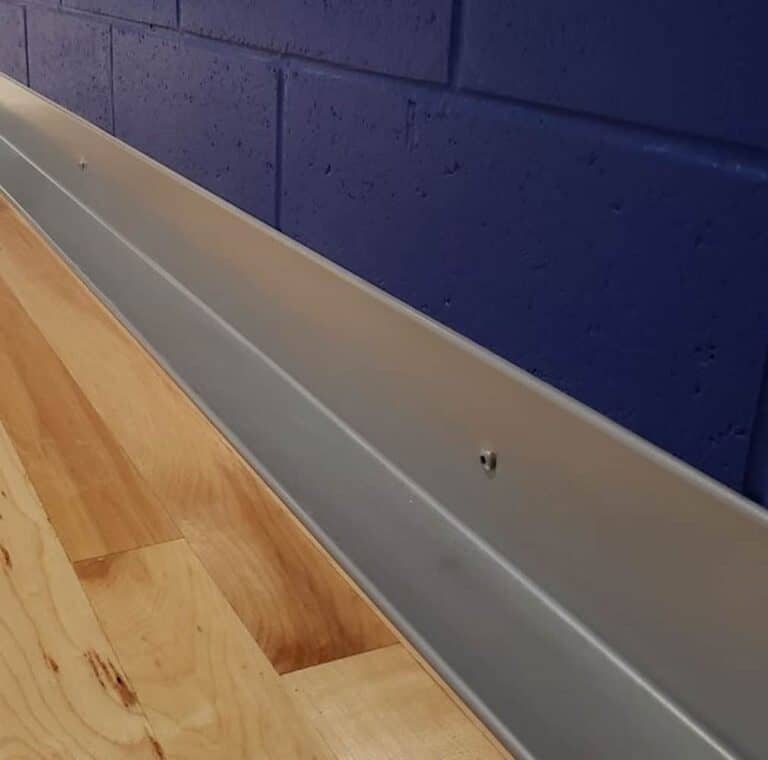
Many maple floors have expansion voids around the perimeter and at columns or floor inserts. They let the floor expand and contract without damage, and MFMA notes perimeter voids also provide ventilation for the floor system. Connor Sports says never to block or obstruct these spaces. Check that the vented cove base is attached and clear, and that mats, carts, and stored equipment are not pushed against it.
Equipment, Wheels, and Heavy Loads
MFMA recommends inspecting wheels before equipment enters the gym. Damaged, crowned, or center-ridged wheels create concentrated point loads. Connor Sports adds shoe cleats and table or chair legs with small contact points to that list. Protect the floor when moving bleachers, portable goals, lifts, or stages, and follow your contractor’s protection plan for heavy lifts. The total weight of the equipment is not the only consideration. Gym Floor Resource’s guidance, not an MFMA requirement: Wheel size, wheel material, contact area, load distribution, and the construction of the gym floor system all affect the potential for damage. Consult your sports flooring contractor before operating scissor lifts or other heavy equipment on the court.
Room Temperature and Humidity
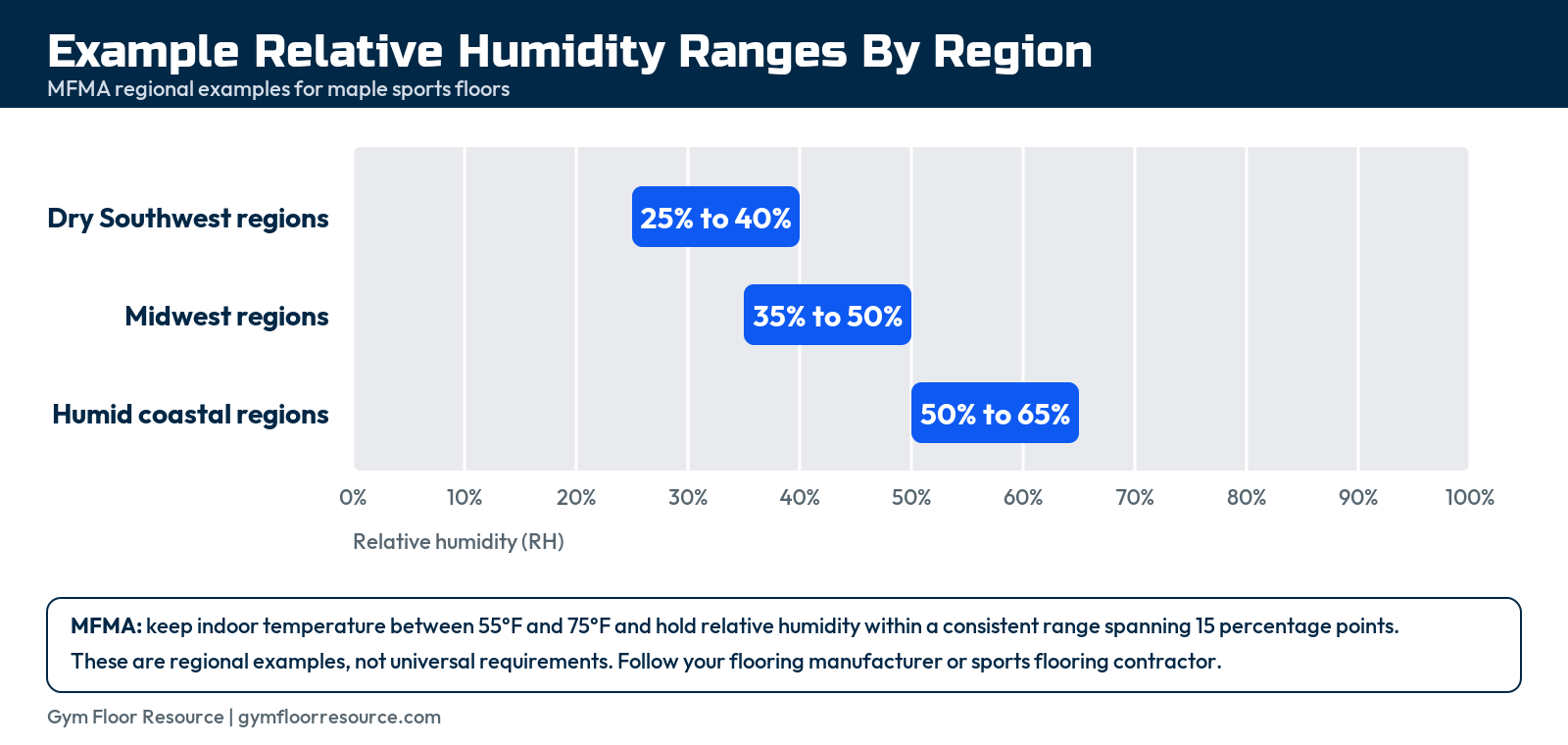
MFMA recommends keeping indoor temperature between 55°F and 75°F and relative humidity within a 15% range. That range shifts by region.
| Region | Example Relative Humidity Range |
|---|---|
| Dry Southwest regions | 25% to 40% |
| Midwest regions | 35% to 50% |
| Humid coastal regions | 50% to 65% |

These are regional examples, not universal requirements. Follow the environmental requirements established by your flooring manufacturer or sports flooring contractor. MFMA recommends maintaining relative humidity within a consistent range spanning 15 percentage points. Set your target with your sports floor contractor and keep the HVAC system running, even during breaks. A Smart Logger V2 records ambient room conditions, and a Floor Sentry monitors conditions inside the wood floor. Compare options in our gym floor humidity monitoring guide.
How to Record What You Find
MFMA recommends keeping maintenance records. For each finding, write down:
- Date and inspector: Who checked the floor and when.
- Location: Mark it on a court diagram using game lines as reference points.
- Conditions: Room temperature and relative humidity at the time.
- Photos: Take a wide shot and a close-up of the problem area.
- Follow-up: Who was notified and what was done.
Do not put tape on the floor to mark a spot. MFMA’s no-tape guidance is about tape left on a finished floor to mark boundaries or spots. MFMA does not recommend tape on a finished maple floor because it can peel away layers of finish when removed, and adhesive resins can stain the finish or the wood.
When to Call Your Sports Floor Contractor
When Should You Close a Gym Floor or Call a Contractor?
Certain gym floor problems require immediate attention, while others should be documented and monitored.
These are Gym Floor Resource safety recommendations built on MFMA and manufacturer guidance. They are not MFMA requirements.
Conditions Requiring Immediate Attention
Restrict access to the affected area or close the court when necessary if you discover:
- Buckled, loose, or raised flooring.
- Splintered or damaged boards that could cause injury.
- Standing water or suspected water beneath the floor.
- Unusually slippery areas that cannot be corrected through routine cleaning.
- Significant floor movement or instability.
- Any condition that may compromise athlete safety.
Notify your facility manager and contact a qualified sports flooring contractor as appropriate.
Conditions Requiring Professional Evaluation
Contact your sports flooring contractor if you notice:
- Excessive or persistent gaps between boards.
- Cupping, crowning, or compression ridging.
- Areas with noticeably reduced ball rebound.
- Persistent or unusual squeaking.
- Peeling, flaking, or excessively worn finish.
- Damage to expansion areas or the subfloor system.
Consult your contractor before sanding, modifying, or making structural repairs to the floor.
If parties involved in an installation or maintenance dispute cannot agree, MFMA offers impartial third-party inspection services for MFMA maple flooring systems.
Synthetic and Rubber Sports Floors
Can This Checklist Be Used for Synthetic and Rubber Gym Floors?
This checklist is designed primarily for hardwood maple sports floors. While many routine checks also apply to synthetic and rubber gym floors, these surfaces have different maintenance and inspection requirements.
For synthetic and rubber sports floors, also check for separating seams, tears, surface bubbling, indentations, and loose or damaged sections. Always follow the flooring manufacturer’s specific inspection, cleaning, and repair recommendations.
Keep Your Gym Floor Inspection-Ready
Products That Help Prevent Common Gym Floor Problems
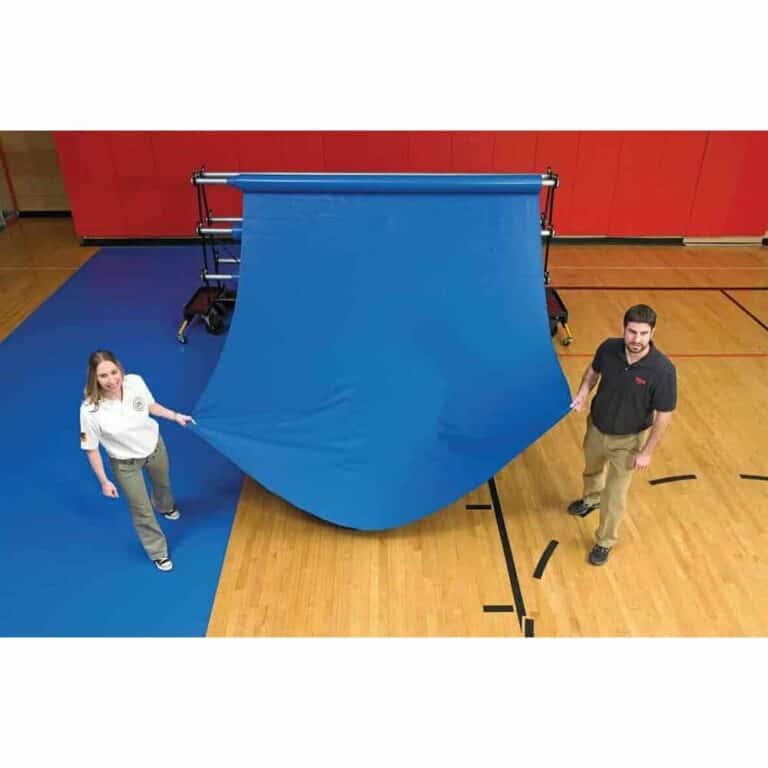
Many gym floor inspection findings can be addressed or prevented through proper cleaning, environmental monitoring, and surface protection.
| Common Concern | Recommended Product Category |
|---|---|
| Dust, dirt, and abrasive debris | Gym floor dust mops |
| Dirt, perspiration, and body oils | Gym floor cleaners |
| Moisture and dirt entering the gym | Entrance mats |
| Temperature and humidity fluctuations | Temperature and RH data loggers |
| Damage during non-athletic events | Gym floor covers |
| Worn floor finish | Gym floor finishes and coatings |
Regular inspections work best when combined with an established maintenance program. For more information, see our daily and weekly gym floor maintenance guide and monthly and seasonal gym floor maintenance guide.
Contact Gym Floor Resource for help selecting the right cleaning, monitoring, and protection products for your sports floor.
Frequently Asked Questions
What Should a Gym Floor Inspection Checklist Include?
A good checklist covers the surface, the finish, and the room. Look for grit, spills, scuffs, gaps between boards, cupping or crowning, low ball bounce, worn or peeling finish, leaks near doors and windows, blocked expansion voids, and damaged equipment wheels. Record temperature and humidity every time.
How Often Should a Gym Floor Be Inspected?
Do a quick visual check every day while you dust mop. Walk the full floor, edges, and entrances at least monthly and after wet weather. Check conditions during school breaks, and do a documented inspection before the annual screen and recoat MFMA recommends for most gym floors.
What Humidity Should a Wood Gym Floor Be Kept At?
MFMA recommends maintaining an indoor temperature between 55°F and 75°F and relative humidity (RH) within a consistent range spanning 15 percentage points, such as 35% to 50%. The appropriate humidity range varies by geographic region. Follow your flooring manufacturer’s environmental requirements and keep the HVAC system running year-round, including during school breaks.
How Do I Know If Gaps Between Gym Floor Boards Are a Problem?
Some gaps are normal in dry months and usually close as humidity rises. MFMA’s rule of thumb is that a gap wide enough to fit a quarter is excessive. If wide gaps stay while the room is in range, contact your flooring installer.
What Is a Dead Spot on a Gym Floor?
MFMA defines a dead spot as an area where ball rebound is noticeably lower than on most of the playing surface. A difference in sound alone does not indicate a dead spot. Mark the location on a court diagram and have a qualified sports flooring contractor evaluate the area.
What Is the Difference Between Cupping and Crowning?
Cupping occurs when the edges of a wood floorboard sit higher than its center. Crowning is the opposite, with the center higher than the edges. Both conditions can result from moisture imbalances. Identify and correct the underlying cause, allow the floor to stabilize, and consult a qualified sports flooring contractor before sanding or making repairs.
Can Custodians Fix Gym Floor Problems They Find During an Inspection?
Yes, for routine care. Custodians can dust mop, wipe up spills, and remove scuffs with an approved cleaner. For structural problems, MFMA advises consulting your MFMA contractor before modifying or repairing a maple sports floor, so report those instead of fixing them.
When Does a Gym Floor Need to Be Screened and Recoated?
MFMA recommends an annual screen and recoat for most maple gym floors. Facility use, maintenance, and floor condition set the exact schedule. MFMA also recommends a full resand every eight to ten years. Your sports floor contractor can confirm the right timing for your floor.
What Are the Warning Signs of a Damaged Gym Floor?
Common warning signs include excessive gaps between boards, cupping, crowning, buckling, loose or splintered boards, reduced ball rebound, peeling finish, and unusual floor movement. Water damage and sudden changes in floor condition should be investigated promptly. Restrict access to areas that may present a safety hazard.
What Causes a Wood Gym Floor to Buckle?
Wood gym floor buckling can occur when excessive moisture causes the flooring to expand beyond the available space. Water leaks, flooding, and high humidity may contribute to the problem. A buckled gym floor should be evaluated by a qualified sports flooring contractor before repairs are attempted.
Who Should Inspect a School Gym Floor?
Custodians, athletic directors, and facility managers can perform routine visual gym floor inspections. Structural damage, suspected moisture beneath the floor, persistent dead spots, and significant changes in floor condition should be evaluated by a qualified sports flooring contractor or inspector.
About This Gym Floor Inspection Checklist
This inspection checklist was developed by Gym Floor Resource, a supplier specializing in products for the installation, maintenance, cleaning, protection, and repair of sports flooring. It is based on published MFMA guidance and sports flooring manufacturer recommendations to help facility managers establish a practical inspection routine.
This checklist is intended for routine facility inspections and does not replace a professional sports flooring inspection or manufacturer-specific maintenance requirements.
Technical References
- MFMA: Daily Floor Care
- MFMA: Frequently Asked Questions
- MFMA: Cupping, Crowning, Compression Ridging & Compression Set
- MFMA: Glossary of Terms
- MFMA: Humidity and Temperature Guidelines
- MFMA: When School’s Out, Keep Your Sports Facility Climate Control On
- MFMA: Screen and Recoat
- MFMA: Floor Surface Protection
- MFMA: Tape on a Maple Floor
- MFMA: Inspection Services
- MFMA: Protect Your Athletic Floor Investment with Proven MFMA Floor Care
- MFMA: 2025 Accreditation Program Study Guide (PDF)
- Robbins Sports Surfaces: Maintenance
- Connor Sports: Wood Care Card (July 2026, PDF)